


Greetings everyone,
After traveling over 9,500 miles, we blew an engine just as the marina came into sight.
It’s scary to think what would have happened if it the engine had blown while we were still in the Arctic. We arrived in Halifax a month ago, and even optimistically, we’re still a couple of weeks away from having the boat running.
If it takes six weeks to get the boat running while docked at a shipyard in a major city, how long would it have taken deep in the Northwest Passage? The season in the passage is short. I’m sure that much of the water we traversed is already packed solid with ice.
We have two engines and could have run on the starboard engine, but it would have been risky. We would have needed to keep the port transmission from overheating as it ‘freewheeled,’ with the boat’s movement through the water spinning the prop. We have a transmission circulation pump to keep the transmission cool when running on a single engine. Theoretically, it would have worked, but we’ve never tested it in real world conditions. At a minimum, it is something we would have needed to keep an eye on.
I’m sure that as a result of our trip through the passage I’ll get calls from other private yacht owners who are thinking about doing the passage. It was an incredible trip and an awesome accomplishment. But, would I recommend it to others? Does the experience outweigh the potential danger? I look back on what we did, and the many ways it could have gone horribly wrong, and it’s a scary feeling. It wasn’t just luck that got us through. It was a very capable boat, an experienced crew, careful planning, and a lot of good luck. If someone has all of that, I recommend the trip. Otherwise, perhaps not.
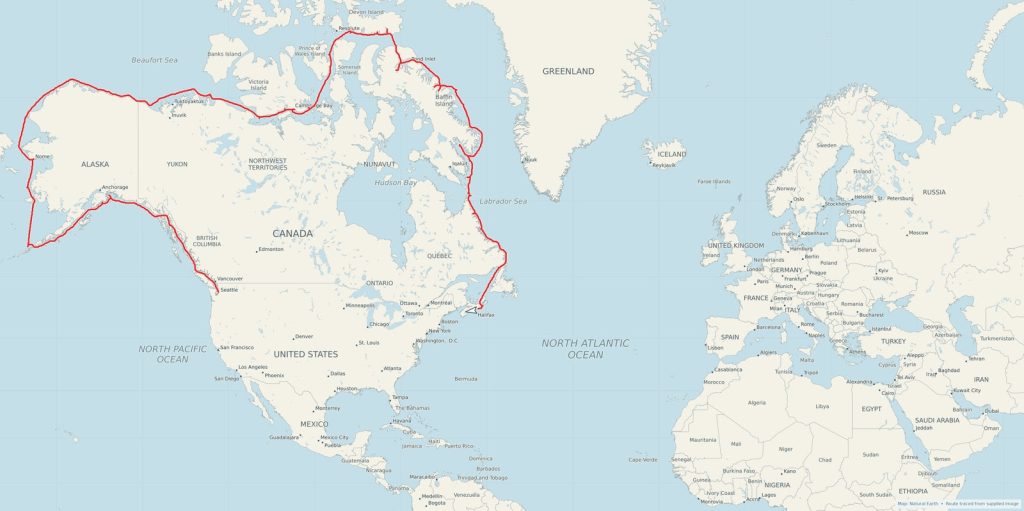
Our 9,517-nautical-mile trip from Seattle to Halifax, Canada. At one point, as near as we could determine, we were the northernmost yacht in North America. There’s an old saying: ‘It’s lonely at the top.’ We can vouch for it.
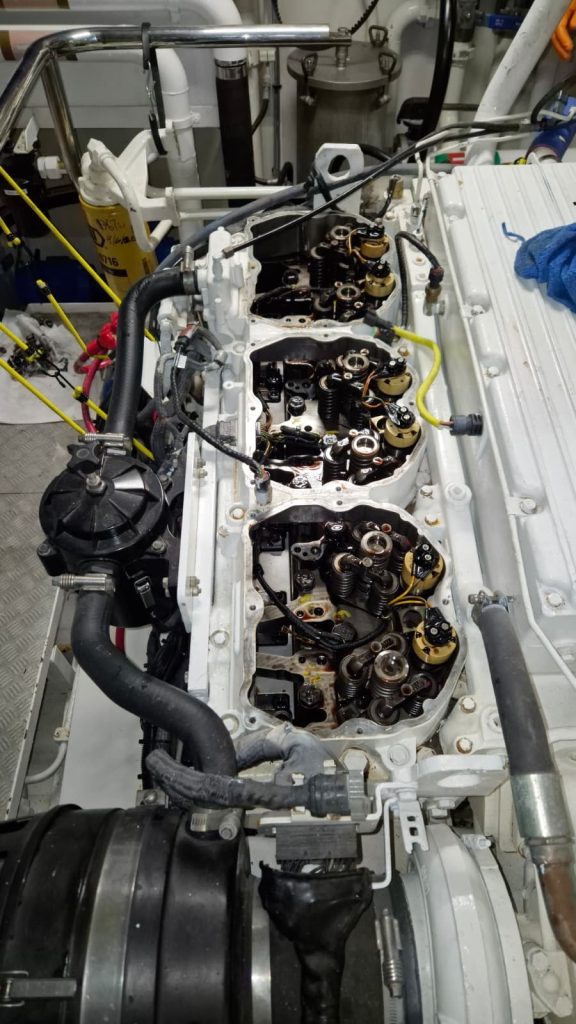
Starting to dig into the port engine
I wish I could tell you for certain what happened to the port engine. We will never be 100% certain, but here is what we believe happened.
Nearly two weeks and 2,200 nautical miles prior to our arrival in Halifax, we had a sudden engine shutdown. We traced the failure to an electrical short in the engine’s wiring harness. We solved the short and the engine started right up and seemed to be fine.
When the engine shut down, it dropped from 1,400 revolutions per minute to zero in under a second. It shut down hard. Unbeknownst to us at the time, we now believe this event caused the threads on the raw water pump shaft to strip, leading to the nut, washer, and gear eventually falling off the shaft.
It was the hardened steel washer from the raw water pump traveling through the gear train that caused the damage. This happened 2 hours outside of Halifax and caused the engine to overheat. The engine was running for about two minutes with this damage. The metal shavings/chunks from this event traveled though the gear train and into the oil pan. At this time, we do not have reason to believe that they traveled anywhere else in the engine.
Why it lived long enough to get us to Halifax we do not know, but we are very happy it did.
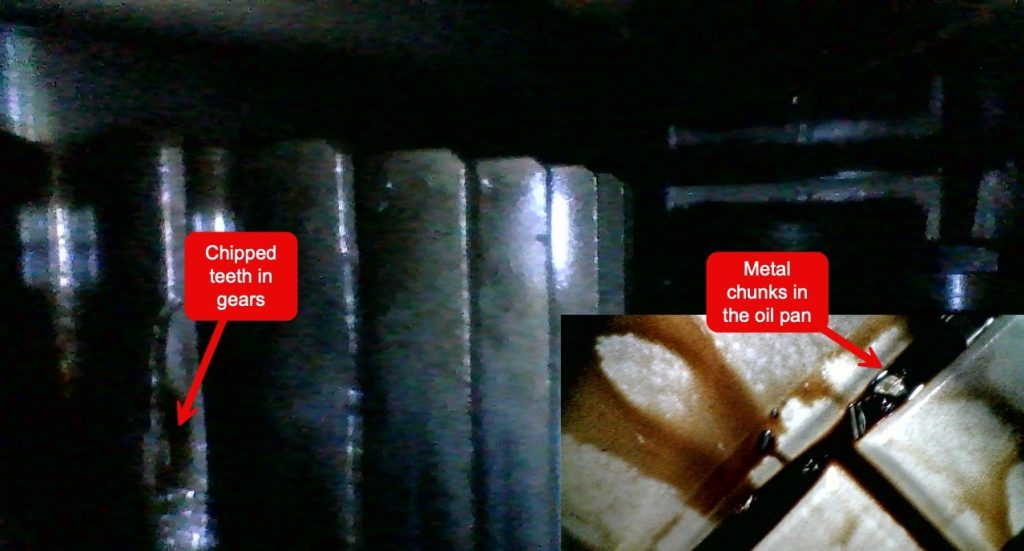
We used a borescope (a camera mounted on the end of a flexible tube) to inspect the engine. We immediately knew we were in deep trouble. Several gears had chipped teeth, scattering metal chunks and shavings throughout the engine.
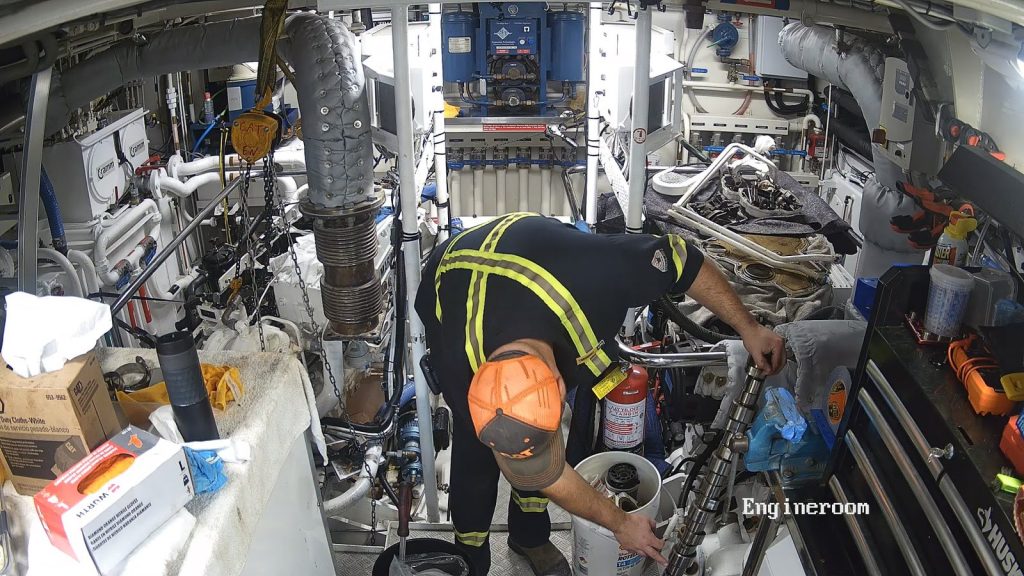
A technician from the local Halifax Caterpillar dealer is dismantling the engine trying to determine the extent of the damage. Here you see him looking at the camshaft. As I am typing this, we are still digging deeper into the engine. On Monday, the gear on the front of the crankshaft will be removed.
We have discussed getting new engines. Even if we get the port engine running, extensive testing of both engines is already planned. The existing 3196 engines have over 11,000 hours on them, but were rebuilt (allegedly zero-houred) prior to our buying the boat. Caterpillar has a newer engine, the C12, that is an easy replacement. Unfortunately, getting a couple of them takes six months. Had they been “in stock,” I would have painfully written a large check and they would be in the boat now.
I briefly considered swapping to Northern Lights Lugger 1276 engines, which would have been less expensive and easier to obtain. I cruised around the world with those engines without incident. They are more readily available and reliable, but it would be a complicated swap with transmission, shaft, engine mount and prop issues. Not worth it.
Right now, all I want to think is, ‘Caterpillar is going to get us going, and soon the boat will depart Halifax for the United States.’ Once we get to the U.S., we will evaluate the engines, and hopefully they’ll get a clean bill of health. That’s the one and only goal at this time.
WHAT HAPPENS WHEN WE GET TO THE U.S.?
We have a spreadsheet with well over a hundred “wish list” items for various repairs to the boat. Most are nonessential, and many date back to things we wanted to do before the Northwest Passage trip but didn’t have time to complete. At this point our focus is on getting the boat south before it becomes trapped by winter storms.
We have spoken to several different yards on the East Coast. Assuming Caterpillar can get the boat moving, we’ll quickly head to a shipyard in Georgia or Florida. With luck, we can be cruising somewhere by January or February.
What we’ll have done in the shipyard is unclear. A top priority will be to have Caterpillar in the U.S. do a deep dive on the engines. We are talking about taking the boat to the Med next summer. I don’t want to make that leap across the Atlantic without engines I absolutely trust. If Caterpillar in the U.S. recommends a rebuild or new engines, then all winter cruising plans will be out the window.
North Star Underwater Drone Footage
The most expensive project on our list is “new bottom paint.” We received quotes from a few shipyards ranging from $62,000 USD to $160,000 USD.
We just painted the bottom prior to our trip through the Northwest Passage. Algae (aka crud) tend to build up more slowly in cold water than in warm water. In warm water, crud can build up in weeks. But algae doesn’t hurt us as much as rust does. If we dinged the bottom anywhere and left bare metal exposed, rust could ultimately eat through the steel plates on the bottom of the boat.
To avoid spending money unnecessarily, we decided to take a hard look at the bottom and review some underwater footage we shot just before arriving in Halifax. We had tangled some weeds in one of the stabilizers and stopped the boat to dig out the weeds.
I put some of the video onto YouTube. It’s overly long (three minutes) and boring, but there is one fun bit: You can see us testing the stabilizer fins by rotating them backwards. Looking at this footage, I see no immediate need for new bottom paint. We’ll take a new look at the end of this winter.
POWELL INLET
My last blog entry had us deep in the Arctic at Beechey Island.
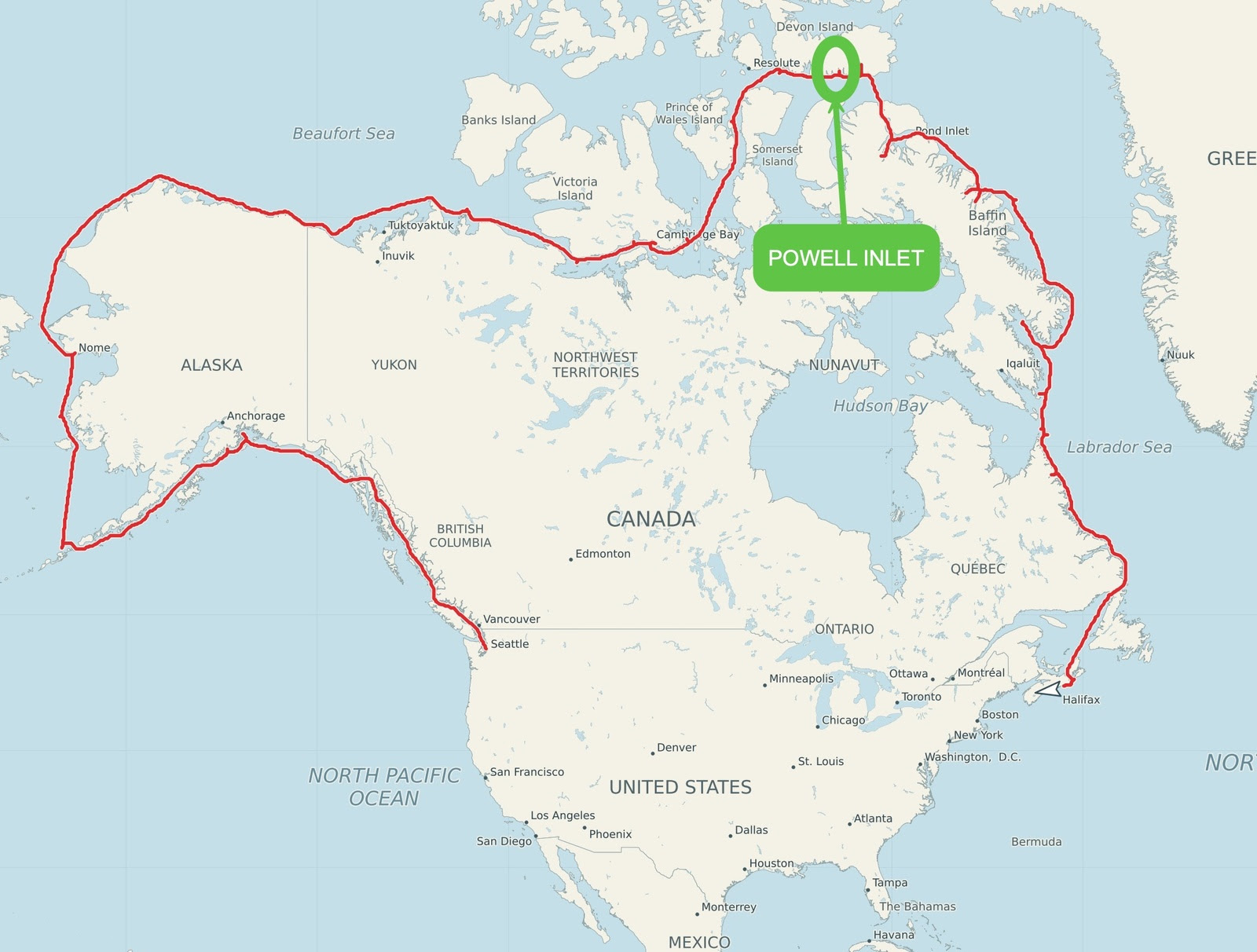
Powell Inlet was near the northern-most point of our trip
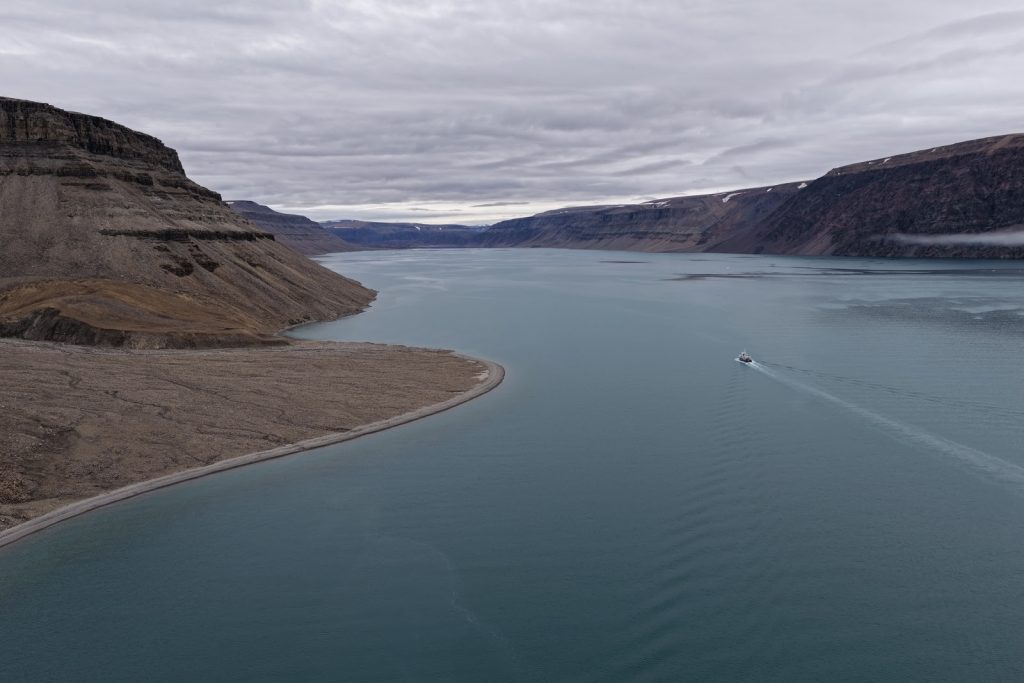
Powell Inlet felt like we were on some sort of alien planet. David Reid, our Expedition Leader, thought it would be a good place to find walruses. The trip felt a little like we had bingo cards and were trying to check off various types of animals: Belugas, check. Orcas, check. Narwhals, check. Eagles, easy check. Etc. The good news was that we were searching for animals, not trees. We went months without seeing a tree.
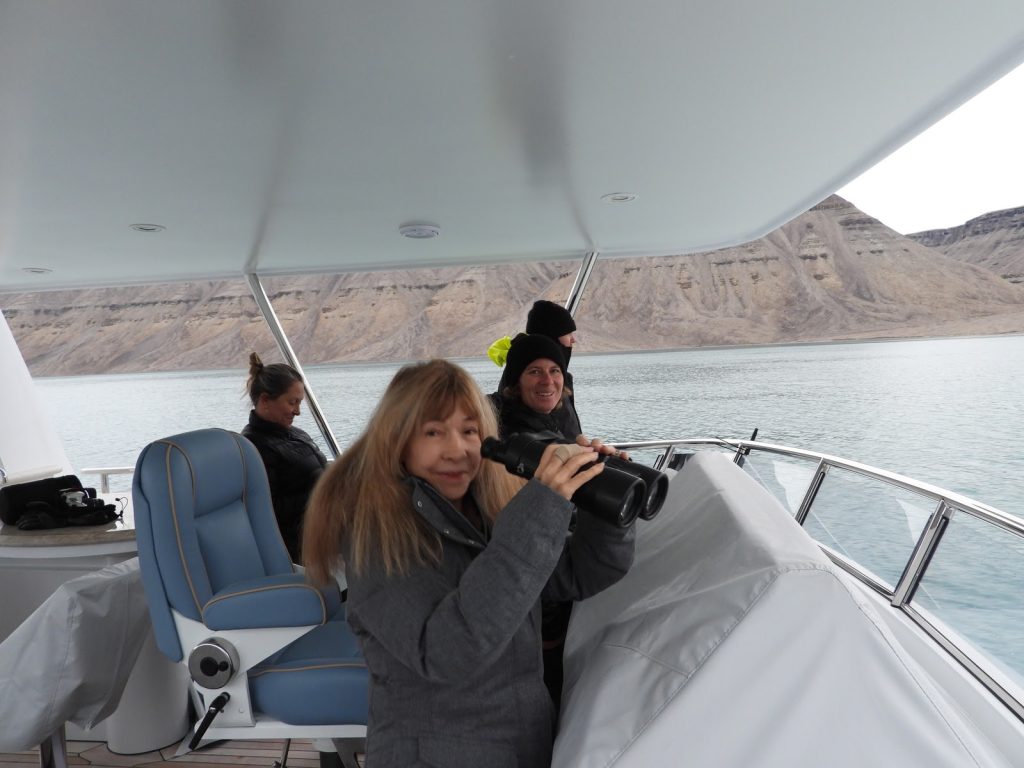
We were scouting the shore looking for polar bears or walruses. Here you see Roberta with the binoculars. Behind her is Mate Kim, and behind her are Chef Dani and another person who might be Mate Lydia, all bundled up.
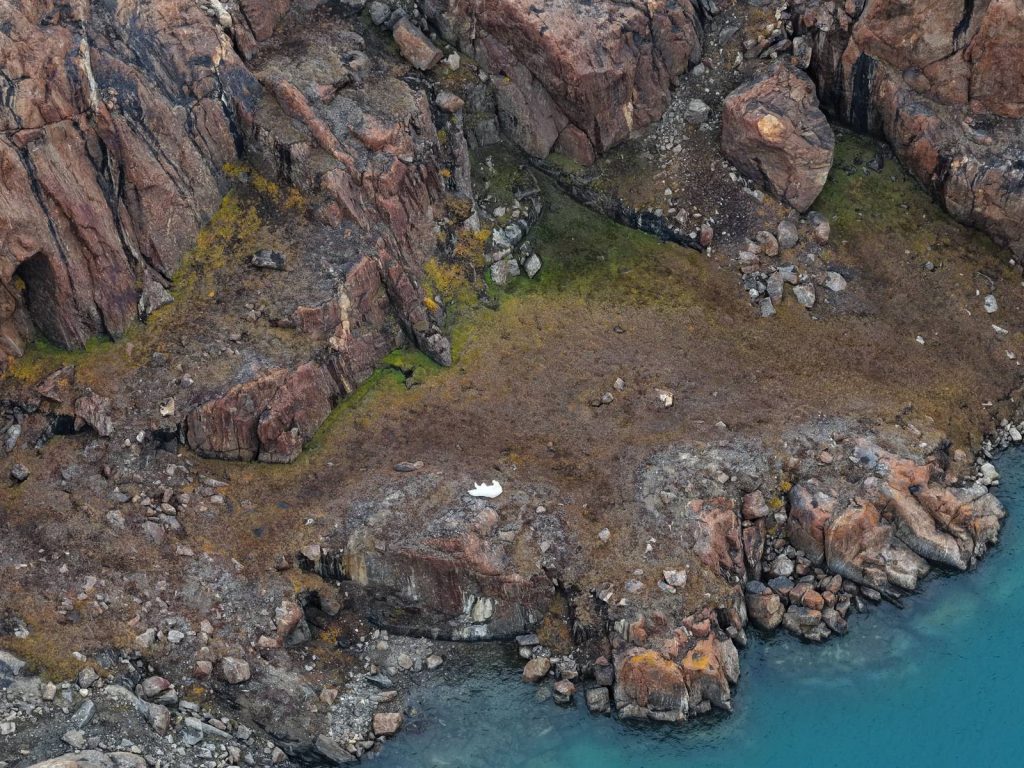
A polar bear happily catching a nap on shore
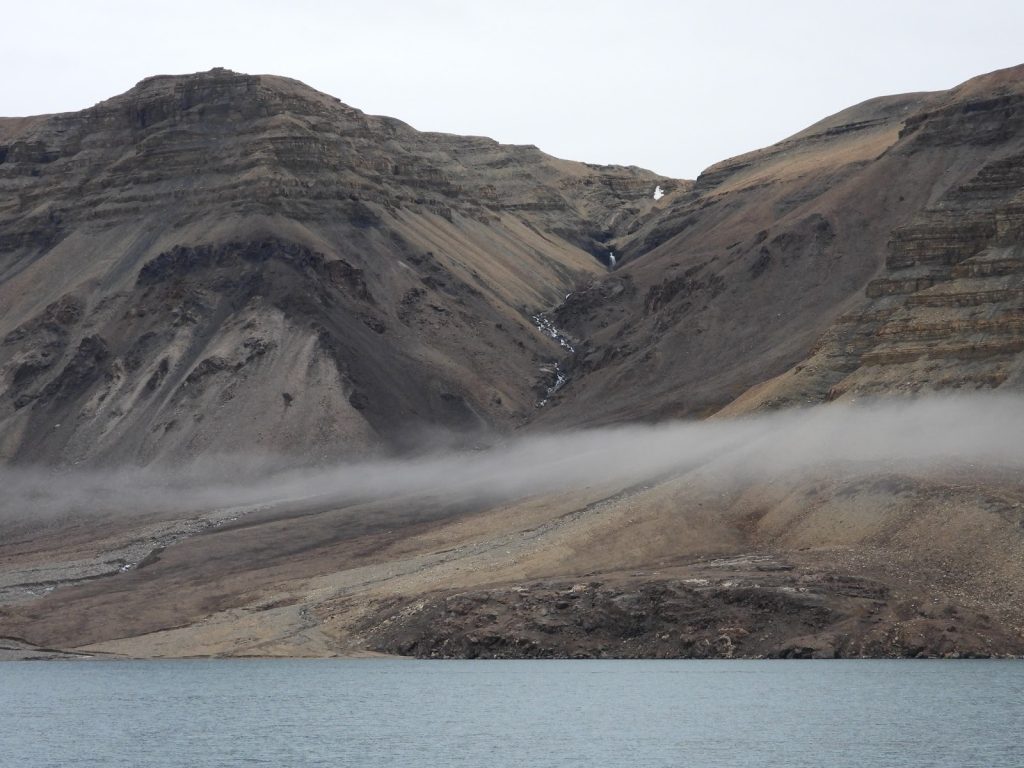
We passed many waterfalls as we continued looking for the elusive walruses
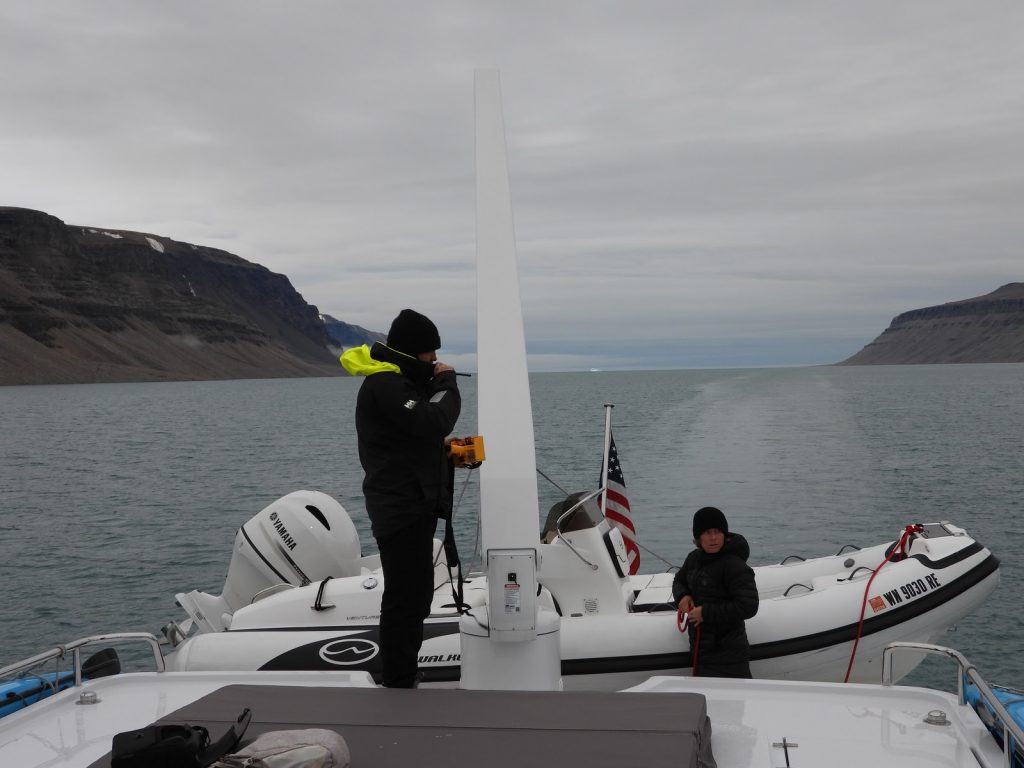
Dropping the tender to scout walruses
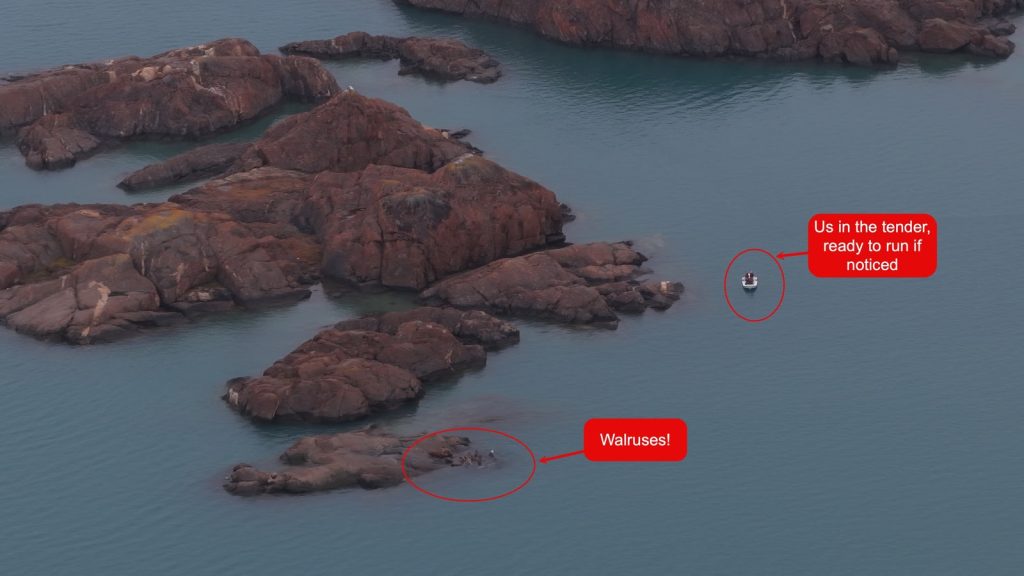
Using a drone, we were able to located the elusive walruses.
However, we wanted to keep our distance and avoid being heard. Once we were within range of our zoom lenses, we stayed still and completely quiet. They never knew we were there. What you see here is as close as we felt we could safely get.
Why Walruses Are Dangerous
- Massive Size and Strength: Adult male Atlantic walruses can weigh around 1,500 kg (about 3,300 lbs), and the largest approach two tons. Their thick hide and blubber act as natural armor.
- Long Ivory Tusks: Both males and females have tusks that can grow up to a meter (about 3 feet) long. They use them to defend against predators like polar bears, pierce ice, and haul themselves out of the water.
- Vessels and Boats: Walruses are known to defend themselves or their territory by ramming, puncturing, or capsizing small boats, kayaks, and research vessels. Historical and modern accounts include incidents where walruses overturned boats or approached divers and kayakers aggressively.
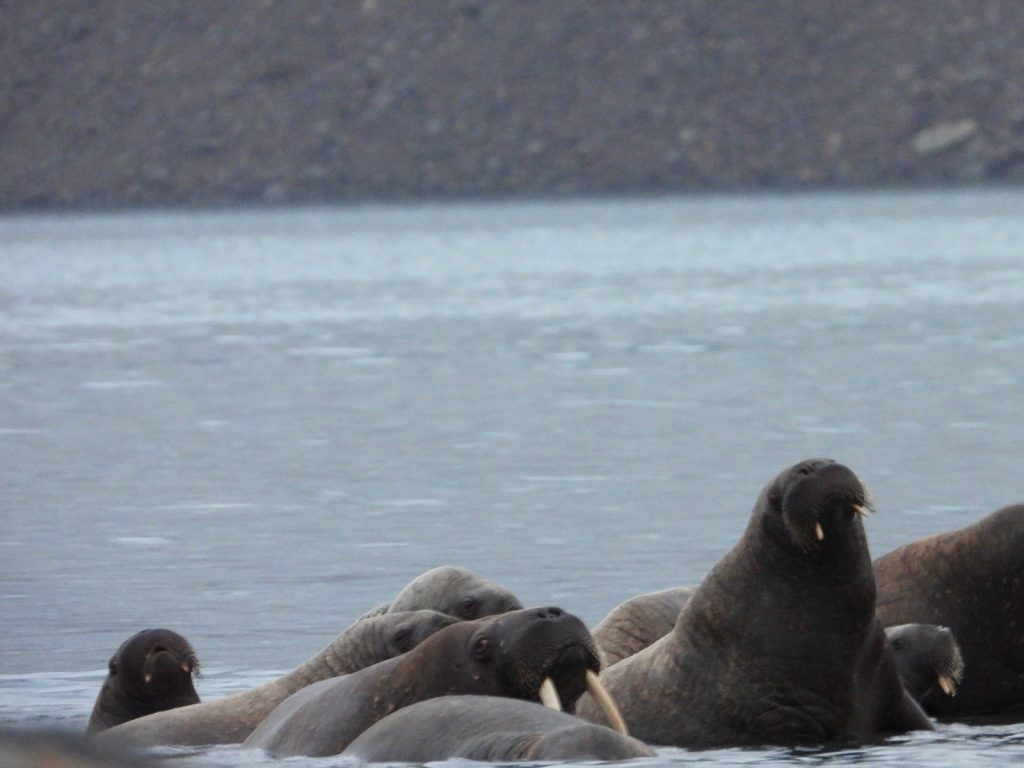
We saw dozens of them sleeping and playing. I’ll post my YouTube blog entry, with video of them, sometime in the next week. Make sure you subscribe to my YouTube channel (https://youtube.com/@mvnorthstar) to check it out.
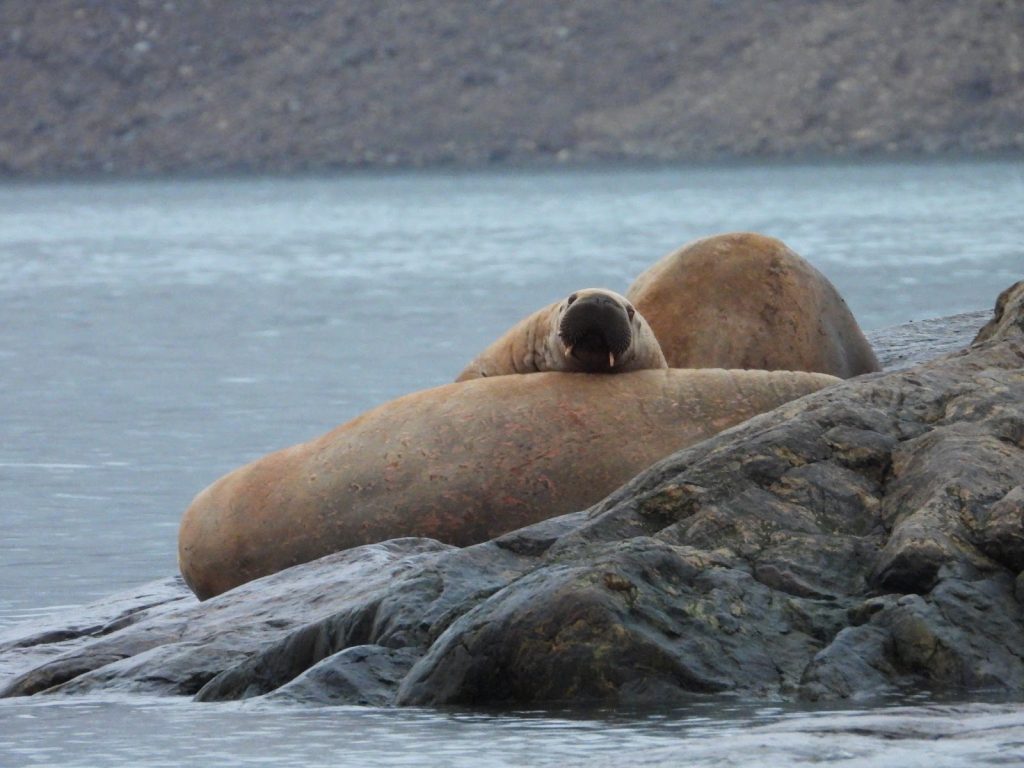
My favorite walrus picture! I’m guessing this is a youngster due to the short tusks.
That’s it for this issue of the blog.
Best wishes and thank you!
Ken and Roberta Williams — and Pixie and Keeley
—
TO SUBSCRIBE ON YOUTUBE
https://youtube.com/@mvnorthstar?sub_confirmation=1
OUR YOUTUBE CHANNEL
https://youtube.com/@mvnorthstar
FOLLOW US ON INSTAGRAM
https://instagram.com/mv_northstar
PAST BLOG ENTRIES
EMAIL NEWSLETTER
If this email was forwarded to you by a friend, and you’d like to be added to this newsletter, click this link:
https://kensblog.eo.page/nh9zj
OUR LATEST VIDEO GAME: COLOSSAL CAVE 3D!
KEN’S MARINE RADAR TRAINING SIMULATOR!
QUESTIONS? COMMENTS?
Ken’s email – ken@mvnorthstar.com
